
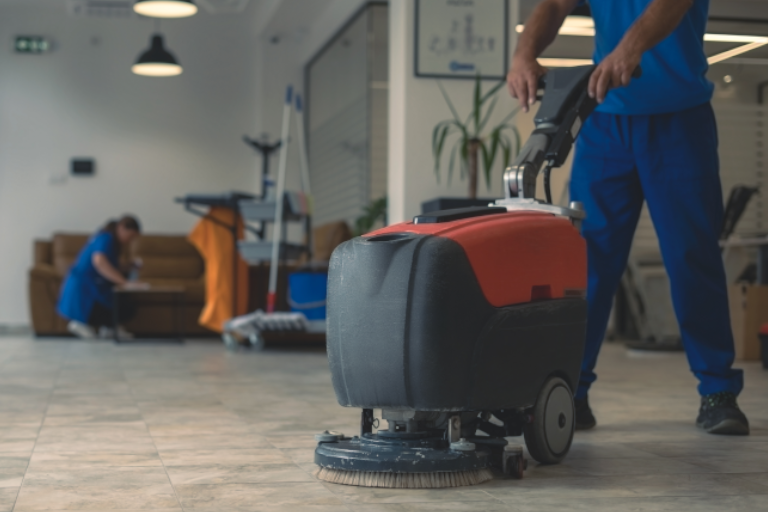
Industrial cleaning machines of all types are usually battery powered. In the past, they used the same battery types as forklifts and other industrial mobile machines. These batteries were based on lead-acid chemistry, and there are many types of lead-acid batteries, including AGM and gel type.
Table of Contents:
Key Takeaways:
- Performance is Superior: Li-ion batteries offer up to five times higher energy density and four times longer cycle life (over 2,000 cycles) than lead-acid, leading to lighter, smaller, and more robust cleaning machines.
- Operational Efficiency: Higher efficiency and shorter charge times make Li-ion ideal for multi-shift operation by minimizing downtime and reducing overall operational and maintenance costs.
- Strategic Advantage: Switching to Li-ion solutions provides higher reliability, increased performance, and reduces the environmental footprint—making it the new standard for efficient and sustainable industrial cleaning equipment.
What Are the Benefits of Lithium-Ion Batteries in the Cleaning Industry?
Lithium-ion batteries are becoming the preferred power source for professional and industrial cleaning machines because they offer longer runtime, lower weight, faster charging, and a significantly longer service life than traditional lead-acid batteries.
All lead-acid batteries offer similar energy density and performance, but their cycle life may vary. In general, however, lead-acid batteries have a relatively low cycle life, especially when compared to li-ion batteries. This limitation becomes even more visible when lead-acid batteries are used in deep discharge cycles.
In the cleaning industry, machines are often operated intensively and frequently discharged to low levels. This makes the limited cycle life of lead-acid technology a significant operational challenge. Repeated deep discharges accelerate battery degradation, leading to more frequent replacements, higher maintenance costs, and increased machine downtime.
Li-ion batteries, by contrast, are far more resilient to deep discharge and partial charging cycles. This allows cleaning machines to operate more flexibly without negatively affecting battery health. This is especially important in real cleaning schedules, where opportunity charging, variable usage patterns, and multi-shift operation are common.
Why Are Li-Ion Batteries Becoming the Top Choice for Industrial Cleaning Machines?
In recent years, li-ion chemistry has emerged as the top choice for new industrial batteries. This is due to its many advantages, including much higher energy density, longer battery cycle life, lower weight, and greater operational efficiency.
Energy density can be up to five times higher in li-ion batteries, with lead-acid batteries typically offering 50-100 Wh/kg, while NCA/NMC cells can reach up to 260 Wh/kg. The battery cycle life is also around four times higher, with less than 500 cycles for lead-acid batteries compared with over 2,000 cycles for LFP li-ion batteries.
This significant performance gap directly affects machine design, productivity, and daily operating costs. Higher energy density allows manufacturers to build more compact cleaning machines or extend runtime without increasing size or weight.
What is more, lead-acid batteries are usually larger and heavier than li-ion batteries. This makes them less suitable for use in modern industrial cleaning machines, where compact design, maneuverability, and easy handling are important.
Excessive battery weight not only limits maneuverability, but also increases mechanical wear on components such as wheels, motors, and frames. Over time, this can raise servicing costs and reduce the overall efficiency of the machine.
Li-ion batteries can last longer and be much lighter, which means cleaning machines can run for longer periods without unnecessary interruptions. In many applications, li-ion batteries reduce or eliminate the need for battery swapping, as fast charging and opportunity charging make it possible to keep machines operating across multiple shifts.
Another important advantage is maintenance. Li-ion batteries do not require regular watering, equalisation charging, or the same level of maintenance as lead-acid batteries. This helps reduce labour requirements, improves convenience for operators, and lowers the risk of maintenance-related mistakes.
It is also the case that the longer service time ensures a longer time between services and slower capacity degradation over time, providing acceptable output over a prolonged period. This stable performance is especially important in professional cleaning environments, where consistent suction power, brush speed, and runtime directly affect cleaning quality and productivity.
When all factors are considered, li-ion batteries for industrial cleaning appliances offer higher performance and lower running costs than lead-acid batteries. As a result, li-ion technology is increasingly viewed not as a premium option, but as the most economically rational choice over the full lifecycle of the machine.
How to Choose the Correct Li-Ion Battery for Cleaning Machines?
It must be remembered that different types of li-ion batteries have different energy densities, maximum power levels, cycle lives, charging capabilities, and safety characteristics. This is why it is important to work with an experienced battery manufacturer when designing a battery system for industrial cleaning equipment.
Selecting the wrong cell chemistry or battery configuration can lead to underperformance, unnecessary oversizing, reduced safety margins, or higher costs. This is particularly important in cleaning machines exposed to moisture, vibration, impacts, temperature changes, and continuous operation.
At EMBS, we have experience with a vast range of cell types from a wide range of producers. We test cells internally and/or in external laboratories to confirm their performance and ensure we recommend the best cell for your application, with the best possible battery life, proper power level, and highest safety.
This approach ensures that each battery system is tailored to the real operational profile of the cleaning machine, rather than relying only on theoretical specifications. The right battery must match the machine’s runtime requirements, charging strategy, peak power demand, working environment, and expected service life.
We can also gather real-life current consumption data from your machine to ensure the power it needs is provided by the battery. By analysing actual usage patterns, peak loads, and duty cycles, we can design battery solutions that deliver optimal performance without unnecessary cost or weight.
A well-designed li-ion battery system can improve cleaning machine performance, reduce downtime, extend service intervals, and lower total cost of ownership. So if you need support in choosing the right battery for your cleaning machine, contact an EMBS specialist.
FAQ
What are the key advantages of lithium-ion batteries compared to traditional battery chemistries?
Why are Li-ion batteries the preferred choice in the cleaning industry?
What performance benefits do Li-ion batteries offer in terms of efficiency, runtime, and charging speed?
How do the safety and durability advantages of Li-ion batteries impact long-term operational costs?
Sources
Liu, K., Wei, Z., Yang, Z., & Li, K. (2021). Mass load prediction for lithium-ion battery electrode clean production: A machine learning approach. Journal of Cleaner Production, 289, 125159.
Lavoie, Y., Danet, F., & Lombard, B. (2017, September). Lithium-ion batteries for industrial applications. In 2017 Petroleum and Chemical Industry Technical Conference (PCIC) (pp. 283-290). IEEE.
About the Author
EMBS
Leading manufacturer of advanced battery systems with a market presence of over 25 years. We specialise in rechargeable lithium-ion batteries, producing a wide range of systems with varying power and capacity.