
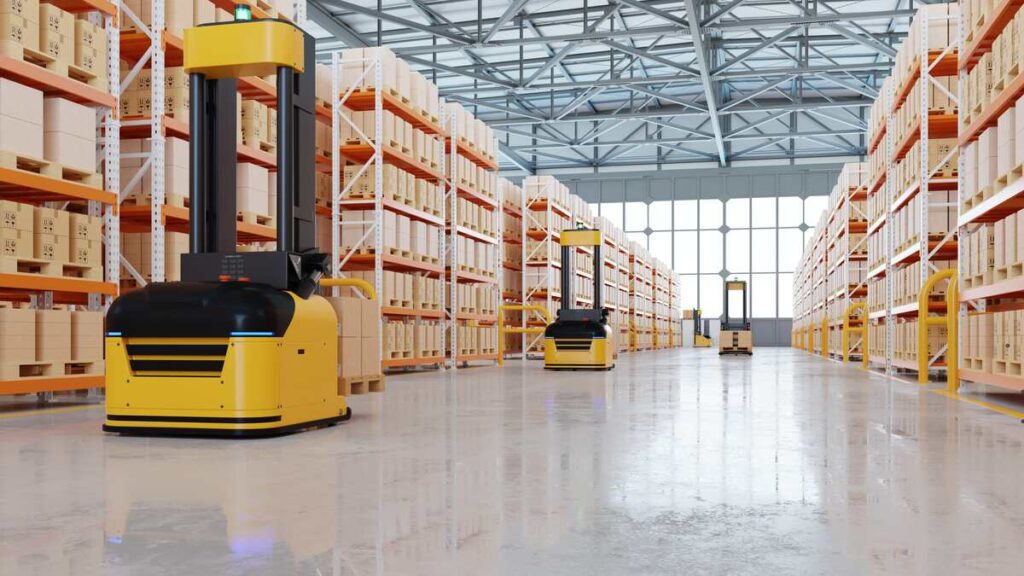
In this article, we discuss AMR & AGV battery types and the technology behind them to help you make better-informed choices when making decisions on your automation needs.
Table of Contents:
Mastering AGV and AMR battery types: Key takeaways
- Choosing between lead-acid and lithium-ion battery types is a strategic decision that determines the efficiency, maintenance costs, and total uptime of your robotic fleet.
- While traditional lead-acid remains a low-cost entry point, lithium-based solutions are the industry standard for high-performance autonomous mobile robots due to their energy density.
- Monitoring future innovations like solid-state cells and hydrogen fuel cells is essential for long-term strategic investment in warehouse and industrial automation technology.
AGVs (Automated Guided Vehicles) and AMRs (Autonomous Mobile Robots) continue to play an ever more prevalent part in many industries. Their role in streamlining material handling and boosting operational efficiency is so palpable that it’s clear these devices are here to stay. But behind their functionality lies a critical component: the battery. For many enterprises, its selection isn’t a technicality but rather a defining decision that will impact their bottom line. In this article, we discuss AMR & AGV battery types and the technology behind them to help you make better-informed choices when making decisions on your automation needs.
Which battery types power modern AGV and AMR systems?
Modern AGV and AMR systems primarily utilize two battery types: traditional lead-acid and advanced lithium-ion. While lead-acid batteries are reliable for heavy, slow-moving vehicles, lithium-based chemistries are rapidly becoming the preferred choice due to their superior energy density, faster charging speeds, and significantly longer operational lifespans in high-demand environments.
Given their reliability and low cost, the first AGVs have traditionally relied on lead-acid batteries, but the industry is now shifting toward lithium-based alternatives due to their efficiency and longevity benefits. Let’s take a closer look at these established solutions.
Lead-acid batteries for AGVs and AMRs
These have been the workhorses of the AGV landscape for a long time. Their low initial cost, reliability, and ability to deliver high surge currents made them a practical choice for early AGV adopters. However, they come with inherent limitations:
- Bulky and Heavy: Lead-acid batteries come with a lower energy density, which impacts maneuverability and runtime.
- High Maintenance: Charging is allowed only under canopy with hydrogen pull-out.
- Slow Charging: Extended charging times lead to operational downtime.
- Shorter Lifespans: Typically, lead-acid batteries last only up to 500 cycles, necessitating frequent replacements.
Lithium-Ion batteries
Lithium-based batteries are quickly replacing lead-acid in AGVs due to their superior performance. The key benefits include:
- higher energy density for longer operational times,
- faster charging for ad-hoc use during short breaks,
- longer lifespan that can exceed 1,000 cycles, slashing costs compared to lead-acid.
Minimal Maintenance: Li-ion batteries don’t require any additional actions for daily usage, making them much more practical for autonomous mobile robot fleets that need to stay in motion to maximize productivity.
What does the future hold for AGV and AMR battery innovation?
Future innovations in AGV and AMR battery technology focus on solid-state cells and hydrogen fuel cells to push the limits of energy density and zero-emission efficiency. These advancements aim to provide even faster refueling times and enhanced safety, allowing robotic fleets to operate continuously in complex industrial environments.
With battery science constantly evolving, future solutions could hit the market with a ripple effect, up-ending the present standards. What other possibilities should you keep an eye on?
Solid-state batteries
Solid-state batteries stand to revolutionize the industry from the ground up. Thanks to their nominally higher energy densities, they can vastly increase the operational capacities of AGVs, AMRs, and many other types of battery-powered devices.
Hydrogen fuel cells
Another potential game-changer are hydrogen fuel cells, which would create zero-emission automation solutions with plenty of density and efficiency to boot. While these technologies are still in development, they are still worth watching for your long-term planning.
Is selecting the right battery type critical for your success?
Selecting the optimal battery type for your AGVs and AMRs is a pivotal decision that directly influences the success of your automation initiatives. Generally speaking, lithium-ion solutions outperform other AMR and AGV battery types in almost every modern metric.
That choice seems clear, especially if you opt for a trusted partner with long-established expertise in the industry, like EMBatterysystems. Contact us today to find out more about our tailored battery solutions that power your business!
Read also: How to Choose the Right Battery for Your AGV or AMR
What battery types have historically been used for AGVs and AMRs?
Why are lithium‑ion batteries increasingly preferred for AGVs and AMRs?
What future battery technologies are mentioned for AGV and AMR applications?
Sources
Interact Analysis. Mobile Robot Market Report: Growth of AGV and AMR in Global Logistics.
International Energy Agency (IEA). Global EV Outlook 2024: Technology Trends for Commercial and Industrial Electrification.
ScienceDirect. Comparative study of thermal stability in NMC and LFP batteries for industrial mobile robots. Journal of Energy Storage
International Energy Agency (IEA). (2024). Global EV Outlook 2024: Moving towards increased electrification.
ISO Standard 3691-4:2023. Industrial trucks — Safety requirements and verification — Part 4: Driverless industrial trucks and their systems.
About the Author
EMBS
Leading manufacturer of advanced battery systems with a market presence of over 25 years. We specialise in rechargeable lithium-ion batteries, producing a wide range of systems with varying power and capacity.